The first months of life are the most decisive for a cat's development. In these weeks, bones, muscles and the immune system form. Incorrect nutrition at this point can have consequences that persist for years.
If you have a newborn or few-week-old kitten, here you'll find everything you need to know: from mother's milk to the transition to solid food, including feeding frequency, key nutrients and foods you should never give.
What does a 1-month-old kitten eat?
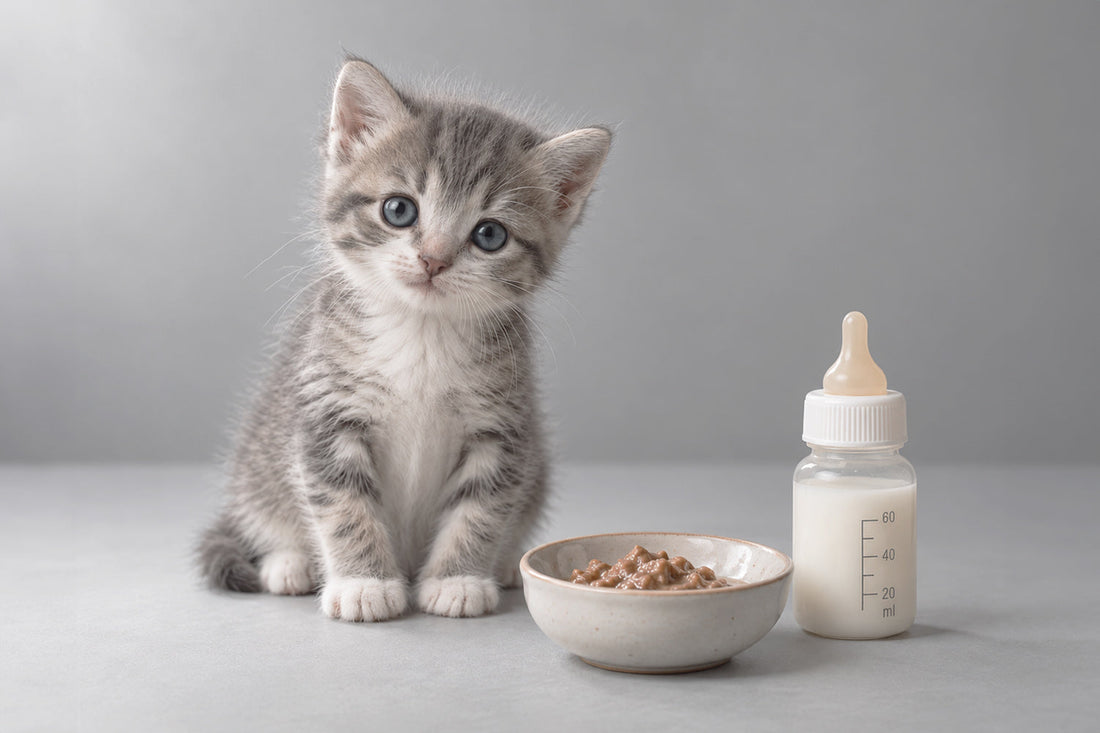
A 1-month-old kitten is still almost entirely dependent on milk. At this age, the digestive system is not ready to process solid food. What it should receive depends on its situation:
- If it has a mother: mother's milk is the only food needed. It contains antibodies, fats, proteins and all the essential nutrients for this stage.
- If it is orphaned or separated from its mother: kitten milk replacer must be used. Never cow's milk or that of other species: it can cause severe diarrhoea and even kidney problems.
At 3-4 weeks you can very gradually start introducing wet food for cats, mixed with warm water or kitten milk replacer to make it easier to consume.
How to feed a 1-month-old orphaned kitten
If you have found a kitten without its mother, follow these steps:
- Always use kitten milk replacer (available from vets or specialist pet shops). Never cow's milk, goat's milk or human milk.
- Temperature: the milk should be around 38 °C (body temperature). Test it on your wrist before giving it.
- Position: the kitten must be lying on its stomach, never on its back. Mimic the natural nursing position.
- Frequency before 3 weeks: every 2-3 hours, including at night.
- Digestive stimulation (essential before 3 weeks): after each feed, gently rub the kitten's belly and genital area with a damp, warm gauze or cotton pad. Until 3 weeks old, kittens cannot urinate or defecate on their own: they need this stimulation or their bladder may collapse.
Feeding schedule by week
The transition from milk to solids follows a natural rhythm that should be respected:
- Weeks 1-3: exclusively mother's milk or kitten milk replacer, every 2-3 hours.
- Weeks 3-4: very soft wet food mixed with liquid is introduced. The kitten starts to explore solids.
- Weeks 5-6: the proportion of solid food increases, liquid decreases. The kitten starts to chew.
- Weeks 7-8: most of the diet is already solid. Milk becomes supplementary.
- From 8 weeks: fully weaned. The kitten feeds independently on solid food.
Weight curve: how to know if it's growing well
A healthy kitten gains between 10 and 15 grams per day during the first weeks. It's important to weigh it every day at the same time with a kitchen scale. An indicative reference:
- At birth: 90–120 g
- 1 week: 150–200 g
- 2 weeks: 200–300 g
- 1 month: 350–500 g
- 2 months: 500–800 g
If the kitten doesn't gain weight in 24 hours or loses weight, consult the vet immediately.
How often should it eat?
- Weeks 1-3 (without mother): 6-8 feeds per day, every 2-3 hours
- Weeks 3-6: 5-6 feeds per day
- Weeks 6-12: 4-5 feeds per day
- 3 to 6 months: 3-4 feeds per day
- From 6 months: 2-3 feeds per day
Key nutrients in a kitten's diet
- High proportion of animal protein: essential for muscle, nerve and organ development. Cats cannot synthesise taurine on their own; this amino acid is essential for heart health and vision.
- Quality fats: concentrated energy source during growth. DHA fatty acids contribute to neurological development.
- Calcium and phosphorus in adequate ratio: fundamental for bone development. Imbalance can cause serious skeletal problems.
- Preformed vitamin A: cats cannot convert beta-carotene; they need to obtain it from animal sources.
- Low carbohydrate content: feline physiology is adapted to a diet with little grain and starch.
- In cases of weakness or recovery, specific supplements for cats can complement the diet under veterinary supervision.
Wet food or dry kibble for kittens?
Wet food
It is especially recommended in the early stages. It provides additional hydration — cats naturally drink little —, is easy to chew and has a higher proportion of animal protein. Learn more about its benefits in the article on the benefits of wet food for cats.
Dry kibble
Convenient and easy to portion. It contributes to dental health thanks to the mechanical chewing effect. It must be specific to kittens: kibble for baby and junior cats is formulated to meet the needs of this stage with high protein, low grain content and no artificial preservatives.
Combination of both
Many specialists recommend combining wet and dry food. Wet food provides hydration and palatability; dry food facilitates handling and cares for teeth.
Forbidden foods for kittens
- Onion, garlic and leek (raw, cooked or powdered): toxic to red blood cells, can cause haemolytic anaemia.
- Chocolate and caffeine: contain theobromine, dangerous for the nervous system and heart.
- Grapes and raisins: can cause acute kidney failure.
- Cow's milk: most cats are lactose intolerant after weaning.
- Cooked bones: they splinter and can cause internal perforations.
- Salted tinned tuna: in the long term can cause vitamin E deficiency and kidney problems.
- Alcohol and xylitol: extremely toxic even in small amounts.
How to make the food transition
When you change brand or type of food, do it progressively over 7-10 days:
- Days 1-3: 75% old food + 25% new
- Days 4-6: 50% of each
- Days 7-9: 25% old + 75% new
- Day 10: 100% new food
Warning signs: when to go to the vet
Consult the vet immediately if you observe:
- The kitten has not nursed or eaten for more than 4 hours
- Weight loss or stagnation for more than 24 hours
- Persistent diarrhoea or blood in stools (see the article on cat diarrhoea)
- Very bloated or hard abdomen
- Extreme lethargy, hypothermia or continuous crying
- No urinating or defecating after stimulation (in kittens under 3 weeks old)
In the first days of life, problems can worsen quickly. Early intervention makes the difference.
Frequently asked questions
Can I give cow's milk to a 1-month-old kitten?
No. Most cats are lactose intolerant. If the kitten doesn't have a mother, use exclusively kitten-specific milk replacer.
When can it start eating dry kibble?
From 6-8 weeks, when the milk teeth are already present and the kitten chews easily.
What do I do if the kitten doesn't want to eat?
Check the milk temperature (38 °C), the position and that the bottle flows well. If it hasn't eaten for more than 4 hours, go to the vet.
When will it need adult food?
Kitten food is recommended up to 12 months for small and medium breeds, and up to 18-24 months for large breeds.
Next stage: the 3-month-old cat
Once weaning is complete, needs change. Consult the feeding guide for the 3-month-old cat to adapt the diet to this new growth phase. If you want to learn more about your breed's characteristics, visit the cat breed guide.